Thursday, October 27, 2011

On birthdays and blessings

Today is my birthday. I have taken to writing a list on this day every year to celebrate the things in the world I most cherish, the things that help me understand my place and role, the things that simply make my heart soar. If you're interested in previous lists just go to other Octobers on this blog, you'll find them there.

I am so grateful to be in this beautiful, perfectly broken, transcendent world. And I am grateful for:
  1. Each breath.
  2. My lungs and heart and body.
  3. My senses.
  4. Luscious tastes.
  5. Colors and patterns.
  6. The world rushing by my ears.
  7. And even the persistent whine of tinnitus, that reminds me that I am alive.
  8. The scents that waft by, noticed and ignored.
  9. The touch of my lover's hand, the rasp of my clothing on skin, the breeze on my cheek.
  10. The beloved people in my life, known and unknown.
  11. My family.
  12. My chosen family.
  13. My dear, dear friends.
  14. And those who wander further from me, my co-workers and those I see in passing.
  15. And the strangers I will never know who each have their own complexities, dreams and birthdays.
  16. Story
  17. Art
  18. Music
  19. And the wisdom to occasionally remember that these things feed me as much as any food.
  20. Work. Not merely a job in these tight times, but the work of my hands and my heart.
  21. Craft, the labor to make something good.
  22. The places books take me to.
  23. The joy of discovery. "Oh yes!"
  24. And sharing that discovery. "Oh yes, and..."
  25. My mind. And the range of emotions.
  26. And the minds of others.
  27. The resilience of my body.
  28. The gifts of age.
  29. Wonder.
  30. Disagreement.
  31. Problems to be solved.
  32. And mysteries to ponder.
  33. The places I will never go.
  34. Wildness.
  35. Water.
  36. Wagging dogs.
  37. Language.
  38. Singing, even if others may not appreciate my voice.
  39. Laughing until my stomach hurts.
  40. Good food.
  41. Change. The passage of time and the knowledge that things will change.
  42. Silence.
  43. Unexpected beauty.
  44. And this life. This singular, glorious life.
Any others? 44 seems like such a short list.

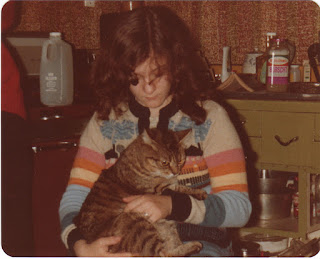
I wanted to end with this picture and the reminder that, no matter how tired, frustrated or fed up we are at any one point in our lives, things will change, whether or not we want them to. We can influence most of those changes and, even if we can't, we can moderate our own responses. The person I was at 12 didn't yet know about the smell of the air in Tuscany, the joy of listening to a new storyteller, that persistence pays off. I feel so tender when I look at her, wishing I could tell her that things will get better. Someday I'll look back at the person I am now, at 44, and marvel at what I didn't yet know.

Oh, and let me add - the cat's name was Taffy. She lived to 18 and was a great friend.

(c)2011 Laura S. Packer Creative Commons License

Thursday, October 13, 2011

Storytelling in a suit: the art and craft of business storytelling


I wrote this article for the Connecticut Storytelling Center's newsletter, HearSay. It's a great publication with all kinds of useful resources. I thought you might find it of interest, so am sharing it with you here. I hope you find it interesting. If you're interested in other storytelling articles, click here. As always, please contact me for reprinting permission.

Human beings are storytelling creatures. From our earliest hunter-gatherer days we have used story to explain and understand ourselves and our world. This is true of organizations as well. The stories organizations tell about themselves (branding, marketing, vision and mission) are how they wish to be seen externally. The stories they tell internally (newsletters, intranets, gossip, employee chatter) are how the organization sees itself. The stories they tell themselves about their customers shape the products they make and the services they offer. None of this is a surprise, of course, since organizations are created and maintained by humans, the storytelling animal.

I’ve always been fascinated by the intersection of business and art, and for the past ten years I’ve worked as an organizational storytelling practitioner helping companies and their employees tell their stories. In the course of this work, I’ve heard a huge range of stories and seen how story helped companies find their voice, solve internal problems, develop new products, expand, grow into better places to work and become better global citizens.

Organizational storytelling is quite different from our usual model of storytelling and yet surprisingly similar.  As storytellers know, when you “story” something, you give it life and depth and meaning. This is true in organizations, as well. Storying a company, a process or a product humanizes it – in a way that a memo or spreadsheet does not – and thus extends ownership throughout the organization or community. The story itself actually becomes a deliverable, a product, alive and vital to the audience, whoever they may be.

But it’s not always a simple process.

Organizational storytelling requires a lot of homework. First, how does the client want to use story? To sell an existing product or service or to design something new? To raise more funds? To attract better talent or further engage their employees? To clarify or develop a mission statement? The practitioner must have an understanding of their client’s stated needs, as well as a toolkit for new needs that may arise.

For example, I was hired by a large agricultural advocacy group to help them develop a new mission for the 21st century so they could grow their membership and attract more funding. They were interested in collecting stories from the farmers and educators within the organization, as well as from other company stakeholders, including board members, marketing personnel and administrators. My client also told me that each invested group thought that their own story should be the focus of the mission, to the exclusion of the others. In short, I was being asked to re-story an organization that had become highly factionalized.

I spent the weeks prior to my first meeting with the group learning as much as I could about their sector of agriculture, about their history and competing organizations. I also sent questionnaires to the workshop participants, and from these I learned essential information about the organization, preliminary stories and a sense of internal themes. I also learned that most of the participants thought storytelling was useless and the event was likely to be a waste of time and money.

On my first day, I wore my suit so everyone would know I took them and their work seriously. When I arrived in the meeting room, each faction sat separately from the other. Arms were crossed. Faces were closed. I began by establishing my credentials: about business, about their business in particular and about storytelling. We introduced ourselves, discussed expectations and set the ground rules – listening skills, honesty, open-mindedness. I talked about how story works and its importance in business. Then I asked them to tell each other stories.

We started with success stories: Tell a story about something you are proud of in your work. Or, tell about a specific time when the work you did had an impact on an individual. From successes, we were able to move to frustrations: Tell a story about a time when you felt hindered in your job.  Finally, they felt safe enough to talk about experiences they perceived as failures. As they told these stories the different factions began to realize that they all were telling very similar stories, with similar themes, that reflected similar values.

Over the course of three days, all the participants told their stories, in small groups and to the whole room. Farmers were talking to educators were talking to other stakeholders. Slowly, they began to distill the values of the organization as it is now (not as it had been) and they came to see the utility of storytelling and listening. By the end of the session we had developed a set of stories that every stakeholder could use, a new set of corporate values derived from those stories and a new mission statement.

They also discovered tools to help identify new talent whose values were aligned with their own and realized the importance to the organization’s growth of hiring people with skills beyond the agricultural realm – that is, to bring in new ideas and new stories. And now they had the skills for listening and collecting those stories.

The board chair told me later that she had been quite skeptical about storytelling as a tool for their organization, "But," she said, “You got us. You understood us.” Because I had learned as much as I could about agriculture and their specific history, I could speak their language, listen for useful motifs and navigate their politics. Had I not done my homework, I would not have been able to help.

When an organization decides to build a storytelling practice, it commits itself to greater authenticity and engagement. Externally, a storytelling organization is better able to articulate its value, regardless of its service or product. Think about your favorite brand. Why do you love it? What stories does it tell? Apple tells stories of good design and human connection. Chrysler recently started telling a new version of the American story with its Imported from Detroit advertising campaign. The Red Cross is there in times of need. Each of these stories somehow resonates with an aspect of being human, some story we wish to tell about ourselves or our community: technology so simple your grandmother gets it yet you still look cool while using it; strength and patriotism; helping and being helped. What’s more, each of these companies tells these stories as personal experiences – someone specific using their product or services.

Internally, a storytelling organization is a listening organization. They listen to their employees’ stories so they can help them become more engaged in their work. For example, I was asked to help a division of a government agency understand why much of their work force had low morale. Because I was a neutral observer, employees were much more forthcoming with me than they would have been otherwise and it quickly became clear that the style of management and conversation was one based on volume, not quality, of ideas. During several listening-based story workshops I lead, the leaders were able to develop new styles of managing while the less assertive employees began to speak up. Employee engagement and retention rose significantly.

A leader who uses story authentically and listens to their employees’ stories can’t help but connect more effectively to everyone they contact in the organization. It becomes harder to make thoughtless management decisions and, as a more positive work environment builds, the organization flourishes.

Storytelling is a broad and flexible tool that can be used successfully in any organization and it gives storytellers a chance to extend the impact of our work. Whether we listen to stakeholders to identify new values, problems or directions; coach a leader to be a better speaker and listener; develop story to communicate how a product or service will or could be used; or help build organizational cohesiveness, storytellers help businesses remember their roots – that they are composed of people, and people, each and every one of us, are composed of story.

(c)2011 Laura S. Packer Creative Commons License

Tuesday, October 11, 2011

We live in a generation of autobiography...

A lovely look at autobiographical travelogue by Lucy Knisley. Worth looking at for any personal storyteller, regardless of medium, particularly the first 10 minutes.

"it's worth knowing you have an audience to share it with, it makes for more responsible work."

"it's important to recognize events in your life, even if they're small and transitional...they help us understand ourselves better."

"journaling is a way to collect your scattered and confused thoughts."


Life is the Story from Lucy Knisley on Vimeo.


(c)2011 Laura S. Packer Creative Commons License

Saturday, October 1, 2011

The visible world

I've lately been taking photographs every day, printing them and pasting them in my journal. I've found I often don't want to write about my life, but I still want to record it, so this seems like a reasonable compromise. I thought I would start sharing some of them with you. None are staged, all are exactly as I found them.

Some of these images act as writing prompts, others simply remind me of where I've been and what I've seen. I'm giving them to you without context, so you can dream them into your own worlds.


(c)2011 Laura S. Packer Creative Commons License

Wednesday, August 17, 2011

Living the life of a storyteller


Image found at http://shannonmcm.com/ 

I spend a lot of time writing about storytelling and various issues in the art. I’ve written about striving for excellence, various performances, listening, telling specific kinds of stories and so on, but I’ve not written explicitly about living the life of a storyteller, how to move through the world so story informs everything you do and everything you do is informed by story, moving through the world prepared to accept the gifts and challenges story brings. In some ways this whole blog is about living the life of a storyteller, so I demonstrate by example, but I thought it might be fun to come up with a list, a few ways that might change the way you think about your life and incidentally deepen your storytelling and other endeavors.

  1. “yes, and…” is the first rule in improv. It's also the first rule in the life of a storyteller. Every experience is fodder for the next story. You see a hippy walking a toy poodle? Great, that could be a story. Your mother calls and talks your ear off? That’s story fodder too. You accept life experiences, joyful or tragic, participant or observer, as opportunities for stories, even if you may never tell the obvious story in front of you. Maybe that toy poodle is really a magical servant. Maybe it’s a hallucination personified. Maybe the hippy is really a breeder of rare dogs. Maybe it was inherited from their just-deceased stock-broker son. You don’t know what the story really is, so you can make it up. It’s your story now. Even if you don’t use the idea immediately, add it to your compost heap, a file somewhere  that contains various ideas, phrases and inspirations for stories. “Yes, and…” also means that you’re willing to risk failing. If you work on a story that doesn’t go where you expected or you get stuck, it doesn’t mean it failed. It means you learned something new about your own process and maybe you should move onto a different story. This one will wait for you. Frankly, “yes, and…” is a pretty nice rule to have for life in general.
  2. Listen. The best storytellers I have ever known are also among the greatest listeners. They know that listening to other tellers and the world around them will only deepen their own telling. By listening intently to other tellers they learn more about the craft of storytelling and increase their understanding of how it works in performance and in the world at large. Great storytellers also listen to the audience. Remember, there is no fourth wall in storytelling, so you can react to your audience in real time. If the audience loves it when you talk about trees and you can do so appropriately in the context of the story, talk about trees more. The meat of the storytelling performance happens in the audience’s head. Listen to them and take advantage of it. Equally, storytellers need to be listened to; practice your new stories with a friendly audience who can give you useful feedback. You get to decide if you use that feedback or not, but a little friendly listening can go a long way. Lastly, when you listen to the world around you, it’s quite likely you’ll overhear stories just waiting to be told.
  3. Praise. Be abundant in your praise of other tellers. Don’t hesitate to tell others what you love about their work and their gift. Just as importantly, accept praise as you receive it. Don’t second guess it or deny the listener’s experience by minimizing their praise. What we don’t need but frequently get or give is “constructive criticism.” Newer endeavors especially thrive when they are fed, not when the roots are plucked off. Heck, be abundant with praise in general. If someone does something well or kind, let them know you appreciate it. How often do you feel appreciated? You’d be surprised how giving appreciation leads to being appreciated. Thanks to Doug Lipman for starting me down the path of being a routine appreciator.
  4. Fail again, fail better. In other words, take risks. If you take no risks in your art or your life you will never grow. Don’t be afraid of failing. Your job is to try new things, fail frequently and to learn from each experience, so you can reach new heights of success.
  5. Change is inevitable. You may be a superb teller of personal stories. You may one day find yourself drawn to tell folktales. This may be frightening but remember, change happens. The only time change stops is when you die. As you try new things, listen, praise and take risks, you will change and grow. The material you are drawn towards will change, as may your audiences. Embrace it. Find a way to make it your own.
  6. Value. No one else does what you do. Your art has value and deserves to be valued. Your whole self deserves to be valued. When you are living the life of a storyteller you may find people under-estimate the time and work you put into your craft. Don’t let them. Make sure they know that your skills are valuable. This must start with valuing yourself. If you don’t know what to charge for your work, ask other tellers what they charge. Don’t be afraid to ask for what you’re worth; you support yourself and your community when you do.
  7. Self-care. No one else is going to take care of you for you. You must understand what nourishes you and your art and provide it for yourself or ask for it clearly and firmly. What is conducive to you doing your best work? Do you need a cup of tea ahead of time? Do you need to run a mile? Do you need space and quiet in which to create? No one will know to give you these things if you don’t ask. Equally, you need to explore what helps you feel most whole, how you can take care of yourself. Maybe you need a bath before you can sleep, or you are renewed by eating sushi once a month. Find a way to care for yourself and you will be a more complete artist.
  8. Abundance and generosity. Assume the world is abundant. That there are ample gigs for all of us, that there are audiences, that you will learn and tell the next story. Be generous with your talent, your compassion and your heart. When we expect abundance the world becomes a much bigger place than when we assume there is scarcity. What we are given or create for ourselves can be accepted with that much more joy. When we are generous it becomes easier to accept the gifts of the universe, because we have become part of the gift of the universe. Envy (I’m a better storyteller than he is) greed (I want more gigs, even if they aren’t right for me) refusal to share (No, I don’t know anyone who can do that gig even though I can’t) all will only keep your heart compressed. Be like the grinch, let your heart grow three times in a day.

You may have guessed this manifesto is about more than being a storyteller, it’s about life. We are all storytellers; the world is our stage and we can decide if our life-long performance is a sold out success or a bust. Go for it. The world is waiting.


(c)2011 Laura S. Packer Creative Commons License

Oddservation - mental health

Two women next to me, practicing mental health assessments. Outside, a man is talking to himself. They adamantly ignore him. Creative Commons License

Oddservation - Pushing buttons

A man walks by pressing a button that emits a distressed bird call. Who or what is he hoping will respond? Creative Commons License

Wednesday, August 10, 2011

Poem: In the Library

First, a confession: Three of the women I love most on the world (my mother and two dear friends) are librarians. I believe librarians and libraries are holders of secret knowledge. Support them.

Second, diversions: I tell several stories set in libraries. I wish any of them conveyed this much mystery this easily. And when my sweetheart suggested he give a room of our apartment over to a library, I knew I was with the right partner.

Third, a journey: I discovered this poet tonight when I was looking for a poem about watermelon. You can read why here.

And that's enough exposition.


In the Library
by Charles Simic

for Octavio

There's a book called
"A Dictionary of Angels."
No one has opened it in fifty years,
I know, because when I did,
The covers creaked, the pages
Crumbled. There I discovered

The angels were once as plentiful
As species of flies.
The sky at dusk
Used to be thick with them.
You had to wave both arms
Just to keep them away.

Now the sun is shining
Through the tall windows.
The library is a quiet place.
Angels and gods huddled
In dark unopened books.
The great secret lies
On some shelf Miss Jones
Passes every day on her rounds.

She's very tall, so she keeps
Her head tipped as if listening.
The books are whispering.
I hear nothing, but she does.


(c)2011 Laura S. Packer Creative Commons License

Tuesday, August 9, 2011

On persistence - Diana Nyad

I've written from time to time about various heroes. Pete Seeger. Mr. Rogers. John Lennon. Dr. King. I have another one.

Diana Nyad is a lot of things. She is a journalist and writer. She is a long distance swimmer who recently, at 61, attempted to swim from Cuba to Florida. She is a lesbian. She is a woman who has overcome any of a number of obstacles to attempt and often achieve her goals.

Why is she one of my heroes? Because of her determination, her outstanding goals and willingness to not achieve them in the effort to be more than she was the day before; attempting the goal, giving it everything, is worth it. Because she is undaunted by age and by the culturally imposed limitations of gender. Because she speaks out.

Diana Nyad undertook her most recent swim from Cuba to Florida for both personal reasons (the public personal reasons have to do with feeling better at 61 than she did at 29, when she last tried this swim) and public reasons (to remind those of us who feel too old to try things that age need not be a limitation). She chose to end her swim when she was just under half-way along, the currents and various physical challenges proved to be too much. Even this is monumental - she swam over 50 miles in 29 hours and made the decision to not permanently injure herself but to end when she could make a the decision to do so. This is the choice of a wise, mature woman.

While Diana didn't complete the swim, she inspired me to strive for bigger goals, to not be afraid of failure, to be strong. She has achieved her goal of inspiring me, and thousands others, to live big, regardless of age. Thank you.

(c)2011 Laura S. Packer Creative Commons License

Wednesday, August 3, 2011

Storytelling and meaning

Storytelling reveals meaning without committing the error of defining it.
                                         Hannah Arendt

When we stand in front of an audience and tell stories, we give our listeners the chance to apply their own meaning to the narrative we present. As storytellers, our job isn’t to be explicit about meaning, but to reveal it as if we are drawing back a curtain to a stage where the audience can both see the story play out and place themselves on the stage. A well-told story gives the listeners a chance to find their own meaning in our words and gestures; a poorly-told story requires that we be explicit in the meaning. It requires that we expose Oz as a fraud; when we spell out that there is no magic, we assume the listener isn’t clever enough to figure it out themselves and certainly not clever enough to understand the magic in the message of the story - that there's no place like home.

Let’s take a look at a story.

Think about the story of Little Red Riding Hood. A child goes into the forest after a warning not to stray off the path. She encounters a wolf, to whom she tells her destination. The wolf races ahead of her, eats her grandmother and ultimately the child. What is the meaning of this story? Is it a warning to not stray off the path? To not talk with strangers? To obey our parents? To be wily in sourcing our supper?

Maybe your understanding of the meaning in Little Red Riding Hood differs from that of your listener. For some it may be a simple warning about the dangers in the woods. For others it may be an allegory for growing up too quickly. Or for abuse. Or for how hunger drives wolves to extreme acts.

Does the story lose power if you conclude with, “And that’s what happens to bad little girls who disobey their mothers and talk to strangers”? Is it more powerful if you use all of your craft to show, not explicitly tell, your meaning in the story, thus leaving the audience with the image of the wolf’s bloody mouth and the child who has been silenced, allowing them to insert their own meaning into the story guided by your images?

I’ve written before about the wonderfully flexible nature of story, the way that the teller cannot control what happens in the listener’s head, so how ultimately our job is to get out of the listener’s way. Storytelling works best when all three players (teller, listeners and tale) are allowed to dance with one another without interference.

If you explicitly tell your audience what the story means then you are cutting into their dance with the tale. It’s inadvisable to do this unless it’s important that the moral be explicitly stated.

You may be thinking that none of this applies to you, that  your stories don’t have deeper meaning. Every story has meaning, because every story is commentary on some aspect of the human condition. When you describe your commute to work you are saying something about your community, your socio-economic status, your feelings about your employment and more. You are also giving your audience the chance to compare your commute story to their own, to put their own feelings and meaning into your story about your wait for the bus or drive through traffic or walk to your office. Stories reveal meaning because story allows humans to connect one to another.

When you develop your stories for performance, decide early in the process what meaning you hope your audience will walk away with. You may find your understanding of a story and your sense of its meaning will change as you tell it, but don’t forget throughout that there is meaning and your audience can be guided in a particular direction. Should they leave with a question? Moral certitude? Construct your telling so that meaning is a likely outcome, but bear in mind you cannot control the story in your listeners’ minds. The best you can do is guide them along a path.

If you want Little Red Riding Hood to be about staying on the path, make sure the danger in straying is apparent as she strays and the consequences are clear. If you want it instead to be about talking to strangers, make that the danger moment. Or, if it’s about cleverly finding new foods for dinner, make sure your wolf is sympathetic, leave little room for your audience to think otherwise.

In revealing meaning without defining it, you have the opportunity to dance with the story and your audience without having to tell them when to turn. You are letting them lead their own internal story and own it, thus making it a more powerful experience for the listener. They will be more invested in the story and in you as a teller, because you trusted their intelligence, the story and your own skill. You didn’t need to show them the man behind the curtain, they knew he was there all along and believed anyway.


(c)2011 Laura S. Packer Creative Commons License
True Stories, Honest Lies by Laura S. Packer is licensed under a Creative Commons Attribution-Noncommercial-No Derivative Works 3.0 United States License.
Based on a work at www.truestorieshonestlies.blogspot.com.
Permissions beyond the scope of this license may be available at http://www.laurapacker.com.
Related Posts with Thumbnails